English Speaking Practice for Job Interviews: How to Prepare
The way to stop freezing in English job interviews is to rehearse out loud — not to write better notes. Practice answering the questions you will actually be asked, speak your answers repeatedly until they flow, and get feedback on grammar and pronunciation so small errors don’t undermine your confidence. Here is a preparation plan you can run in the days before your interview.
Why interviews make your English disappear
Under pressure, your brain prioritizes the content of your answer — and your English, the less automatic skill, collapses first. Candidates who "know English" stumble in interviews because they have never produced professional English out loud under time pressure. The fix is rehearsal: answers you have spoken ten times come out smoothly even when you are nervous, because they no longer require conscious assembly.
The questions to rehearse first
Interviews are more predictable than they feel. Prepare spoken — not written — answers to these, and you have covered most of a typical interview:
- "Tell me about yourself" — a 60–90 second spoken introduction; this sets the tone for everything after.
- "Why do you want this role / why should we hire you?"
- "What are your strengths and weaknesses?"
- "Tell me about a challenge you faced and how you handled it" — use a simple Situation → Action → Result structure.
- "Where do you see yourself in five years?"
- "Do you have any questions for us?" — prepare two questions of your own.
A 5-day speaking practice plan before the interview
-
1 Day 1 — Draft your stories out loud
Don’t write scripts. Speak each answer freely three times; it will tighten naturally. Scripts memorized word-for-word crack under pressure — spoken outlines don’t.
-
2 Day 2 — Fix the language
Practice your answers with a feedback source and clean up recurring grammar mistakes and mispronounced words — especially job-specific vocabulary you’ll definitely need.
-
3 Day 3 — Run a full mock interview
Simulate the real thing end-to-end: unpredictable question order, follow-up questions, no pausing. This is where role-play practice with an AI interviewer shines.
-
4 Day 4 — Drill your weak spots
Re-run only the questions that went badly. Drill mispronounced words individually until they are automatic.
-
5 Day 5 — Light rehearsal and rest
One relaxed run-through of "tell me about yourself" and your two hardest questions. Confidence on the day comes from knowing you’ve already done this conversation before.
How to run mock interviews with Vaani
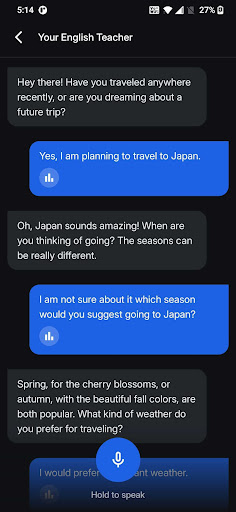
Vaani’s Role Play mode and Work & Career topic let you rehearse interview English in a real back-and-forth voice conversation — with corrections after every answer, and none of the embarrassment of practicing in front of a person.
- 1 Open the Practice Hub, switch to Role Play, and choose an interview scenario — or pick the Work & Career topic for professional conversation practice.
- 2 Answer the AI interviewer’s questions out loud using hold-to-speak, including unexpected follow-ups — just like a real interview.
- 3 Review your accuracy score and instant corrections after each answer: grammar slips, mispronounced words, and stronger word choices.
- 4 Drill the specific words that tripped you up — say your key vocabulary (your job title, your skills) until the accuracy score shows they’re clean.
- 5 Repeat the scenario daily before your interview. Each run gets measurably smoother, and you walk in having already survived the conversation many times.

Free to start · Available 24/7