How to Practice English Speaking at Home — Alone, Without a Partner
You can absolutely practice English speaking at home without a partner. The most effective methods are speaking to yourself out loud, shadowing native audio, recording and reviewing your own speech, and having voice conversations with an AI coach that talks back and corrects you. Here is how to combine them into a practice system.
Why "I have nobody to practice with" doesn’t have to stop you
The old advice — "find a native speaker to talk to" — is impractical for most learners. Language partners cancel, tutors are expensive, and speaking clubs meet once a week at best. Meanwhile, your speaking skill needs daily repetitions. The good news: what builds fluency is your mouth producing English and your brain getting feedback. Both of those are now possible alone, at home, for free.
7 ways to practice speaking English by yourself
-
1 Narrate your life
Describe what you are doing as you do it: "I’m making tea. The water is boiling. I forgot to buy milk." It feels odd for a day or two, then becomes the easiest zero-cost practice there is.
-
2 Shadow native speakers
Play a short clip — a podcast, a series, a YouTube video — and repeat each sentence immediately after you hear it, copying the intonation. Ten minutes of shadowing daily noticeably improves rhythm and pronunciation.
-
3 Record yourself answering questions
Pick a common question ("Tell me about your city"), answer for one minute on your phone’s recorder, then listen back. Note hesitations and repeated mistakes, and answer again.
-
4 Think in English on a schedule
Set two daily moments — your commute, your walk — where you deliberately think in English. This attacks the translation habit that causes hesitation.
-
5 Read aloud for five minutes
Reading aloud trains pronunciation and sentence flow without requiring you to invent content. News articles and simple fiction work well.
-
6 Talk to an AI conversation partner
This is the piece the other methods can’t give you: a real back-and-forth conversation with follow-up questions, plus corrections. AI speaking apps let you converse out loud any time, with no judgment and no scheduling.
-
7 Rehearse tomorrow’s conversations
Have a meeting, a call, or an appointment coming up? Say your part out loud tonight. Rehearsed sentences come out smoothly under pressure.
The missing ingredient when you practice alone: feedback
Self-talk and shadowing build volume, but they share one weakness — nobody tells you what you got wrong. Practicing errors cements them. That is why the highest-value addition to at-home practice is a feedback source: something that hears your English and corrects your grammar, pronunciation, and word choice immediately. This used to require a tutor; now an AI coach does it on every single sentence.
How to practice at home with Vaani
Vaani turns your phone into a speaking partner that is always available, never judges, and corrects every sentence — the exact things solo practice is missing.
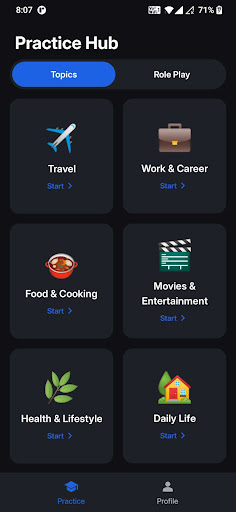
- 1 Pick a topic in the Practice Hub — start with Daily Life if you’re not sure — or choose Role Play for scenario practice.
- 2 Hold to speak and answer naturally. The AI teacher asks follow-up questions, exactly like a real conversation partner.
- 3 Watch your accuracy score after each response and read the instant corrections — mistakes are fixed while the sentence is still fresh.
- 4 Add tricky words to your practice list and drill them with the Listen-and-repeat pronunciation tool.
- 5 Practice at any hour — before work, during lunch, at midnight. No partner, no appointment, no pressure.

Free to start · Available 24/7