How to Speak English Confidently — and Overcome Fear and Hesitation
If you understand English but hesitate to speak it, your problem is not knowledge — it is confidence, and confidence is trainable. The fix is safe repetitions: speaking regularly in a judgment-free setting, making mistakes cheaply, and correcting them, until English stops feeling like a performance. Here is how to break the hesitation loop step by step.
Why you hesitate even though you know English
Hesitation is a loop: you fear making a mistake in front of people → you avoid speaking → you get no speaking practice → your spoken English stays shaky → which confirms the fear. Grammar study cannot break this loop, because the bottleneck was never grammar. Many learners also translate silently from their native language before speaking, which adds a delay that feels like — and gets judged as — not knowing English.
7 steps to build English speaking confidence
-
1 Start where mistakes are free
Confidence grows fastest where the cost of an error is zero. Practice out loud alone or with an AI coach first — no audience, no judgment — and save real-world conversations for when the basics feel automatic.
-
2 Lower the bar deliberately
Aim for "clear and simple", not "impressive". Short sentences you can say fluently build more confidence than long ones you stumble through.
-
3 Get corrections privately
Being corrected in front of others is what made speaking scary in the first place. Private, instant feedback fixes your errors without the social sting — so correction starts feeling like progress, not embarrassment.
-
4 Rehearse high-stakes moments in advance
Meetings, interviews, phone calls: practice the actual conversation out loud beforehand. Walking in with rehearsed openings removes the scariest part — the start.
-
5 Kill the translation habit
Practice thinking in English daily. When you speak directly from thought to English, the hesitation gap that reads as "nervousness" disappears.
-
6 Collect small wins on purpose
One smooth conversation, one question asked in a meeting, one accuracy score improving week over week — logged wins rewire your self-image from "bad at speaking" to "improving fast".
-
7 Expose yourself gradually
Once solo practice feels easy, add mild stakes: a coffee order, small talk with a colleague, a longer comment in a meeting. Each level makes the next one feel normal.
How long until speaking feels comfortable?
With daily practice, most learners feel noticeably less hesitation in 4–6 weeks, and comfortable in most everyday situations within 3–6 months. The mechanism is simple: hesitation shrinks in direct proportion to the number of low-pressure conversations you have had. Every safe rep makes the next real conversation less scary.
How Vaani helps you speak without fear
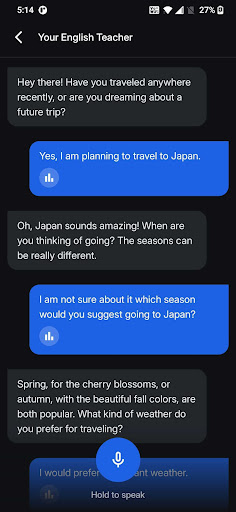
Vaani was built for exactly this user — the person who understands English but feels nervous or stuck while speaking. It is a practice space where mistakes cost nothing and every session ends with visible progress.
- 1 Practice with an AI coach that never judges, never laughs, and never gets impatient — the pressure that blocks you with people simply isn’t there.
- 2 Speak in everyday topics from the Practice Hub (Daily Life, Travel, Food) so you rehearse the exact situations that currently make you nervous.
- 3 Get corrections instantly and privately after each sentence — grammar, pronunciation, and better phrasing — and try again immediately.
- 4 Watch your accuracy scores rise session over session: objective proof that you are improving, which is what real confidence is built on.
- 5 Practice anytime, 24/7 — five judgment-free minutes before a meeting can settle your nerves and warm up your English.

Free to start · Available 24/7