How to Improve English Pronunciation: Exercises That Actually Work
The fastest way to improve English pronunciation is a tight loop of listen → imitate → get feedback → repeat. Hear the correct model of a word, say it, find out exactly how close you were, and drill the specific sounds you miss. Generic "listen to more English" advice fails because without feedback you can’t hear your own errors. Here are the exercises that work.
Why you can’t hear your own pronunciation mistakes
Your brain filters speech through the sound system of your native language. If your language doesn’t distinguish two English sounds — like "ship" and "sheep", or the two th-sounds — you literally hear them as the same, so you can’t self-correct. This is why feedback is not optional for pronunciation: something outside your own ear has to tell you when the sound you produced doesn’t match the target.
6 pronunciation exercises that work
-
1 Shadowing
Repeat sentences immediately after a native speaker, copying stress and melody, not just sounds. English is rhythm-based — getting the stress right often matters more for being understood than perfecting individual sounds.
-
2 Word-level drilling with a model
For each problem word: listen to the correct pronunciation, say it, compare, repeat. Doing this with instant accuracy feedback turns guesswork into measurable progress.
-
3 Minimal pairs
Practice word pairs that differ by one sound — ship/sheep, bat/bet, pray/play — to train your ear and mouth on the exact contrasts your native language lacks.
-
4 Learn basic IPA for your problem words
The phonetic spelling (like /ˈtrævəl/ for "travel") shows you the actual sounds, bypassing English’s misleading spelling. You only need the dozen symbols that appear in your problem words.
-
5 Slow down and exaggerate
Practicing a sound slowly and exaggerated builds the mouth positions correctly; speed comes back on its own. Mumbling through at full speed just rehearses the error.
-
6 Record and compare weekly
Record the same paragraph once a week. Progress you can hear is the best motivation to keep drilling.
Focus on being understood, not sounding native
A useful target is clear, confident English with your own accent — not a perfect American or British accent. Prioritize the errors that cause misunderstanding: word stress, key vowel contrasts, and consistently mispronounced everyday words. Fixing your twenty most-used problem words improves how you sound more than months of generic accent work.
How to drill pronunciation with Vaani
Vaani gives you the feedback loop that solo pronunciation practice lacks: it scores every spoken sentence, highlights the exact words you mispronounced, and turns them into personal drills.
- 1 Have a normal voice conversation in any topic — Vaani listens to every sentence you speak.
- 2 See your accuracy score instantly, with mispronounced words highlighted right in your sentence.
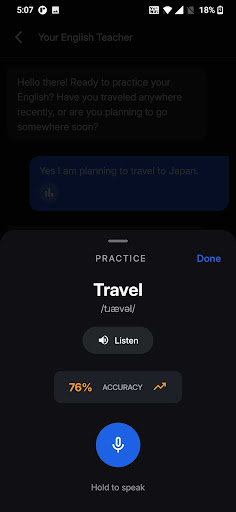
- 3 Tap a highlighted word to open Practice mode: see its IPA (like /ˈtrævəl/), tap Listen to hear the correct model, then hold to speak and imitate it.
- 4 Watch your per-word accuracy climb as you repeat — the score tells you precisely when you’ve got it.
- 5 Your missed words collect in Words to Practice, so every session builds a personal drill list of exactly the sounds you need.

Free to start · Available 24/7